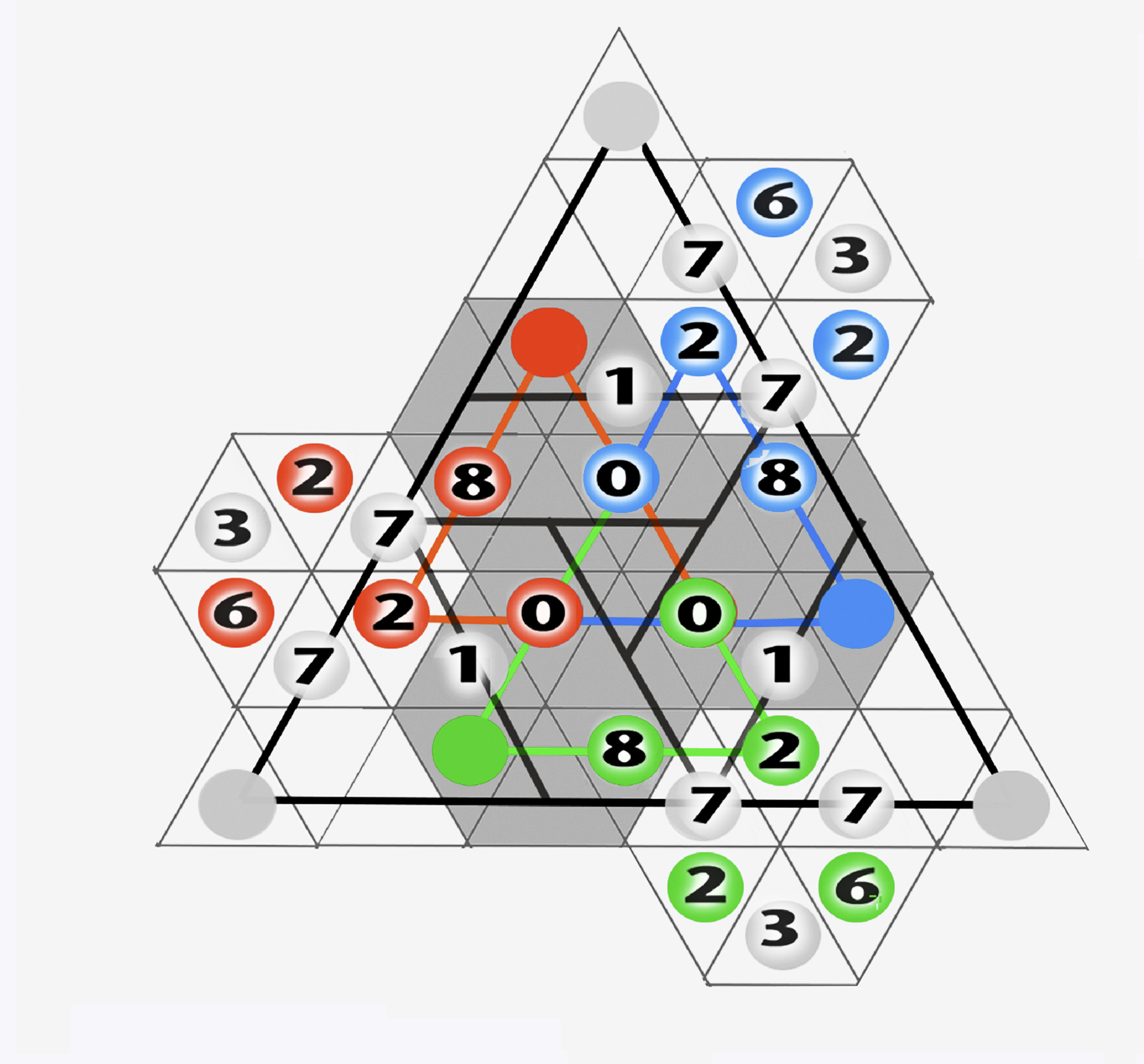
Prime Reciprocal Design
Mechanistic number had its heyday thirty centuries ago when Greek mathematics found a way to miniaturize our solar system into a small jewelry box. Originally thought to be the engineering feat of Archimedes, its complex set of horological gears rivaled the finest Swiss watch, requiring centuries of planetary observations to be distilled as carefully calibrated gear-teeth. As a testimony to forgotten history, this stunning feat of ancient technology was then lost to the record books until the early 1900’s when a Mediterranean shipwreck was dredged up by marine archeologists. Without suspecting the Greeks depth of pure integer-insight in designing this system of precisely numbered interlocking gear-teeth and their celestial mechanics, it took three generations of academic scholars to reverse-engineer its complex simulation of our solar system’s planetary orbits. Sublimely named, the Antikythera mechanism, it retroactively achieved the status of humankind’s first computer.
Particle Physics Nutshell
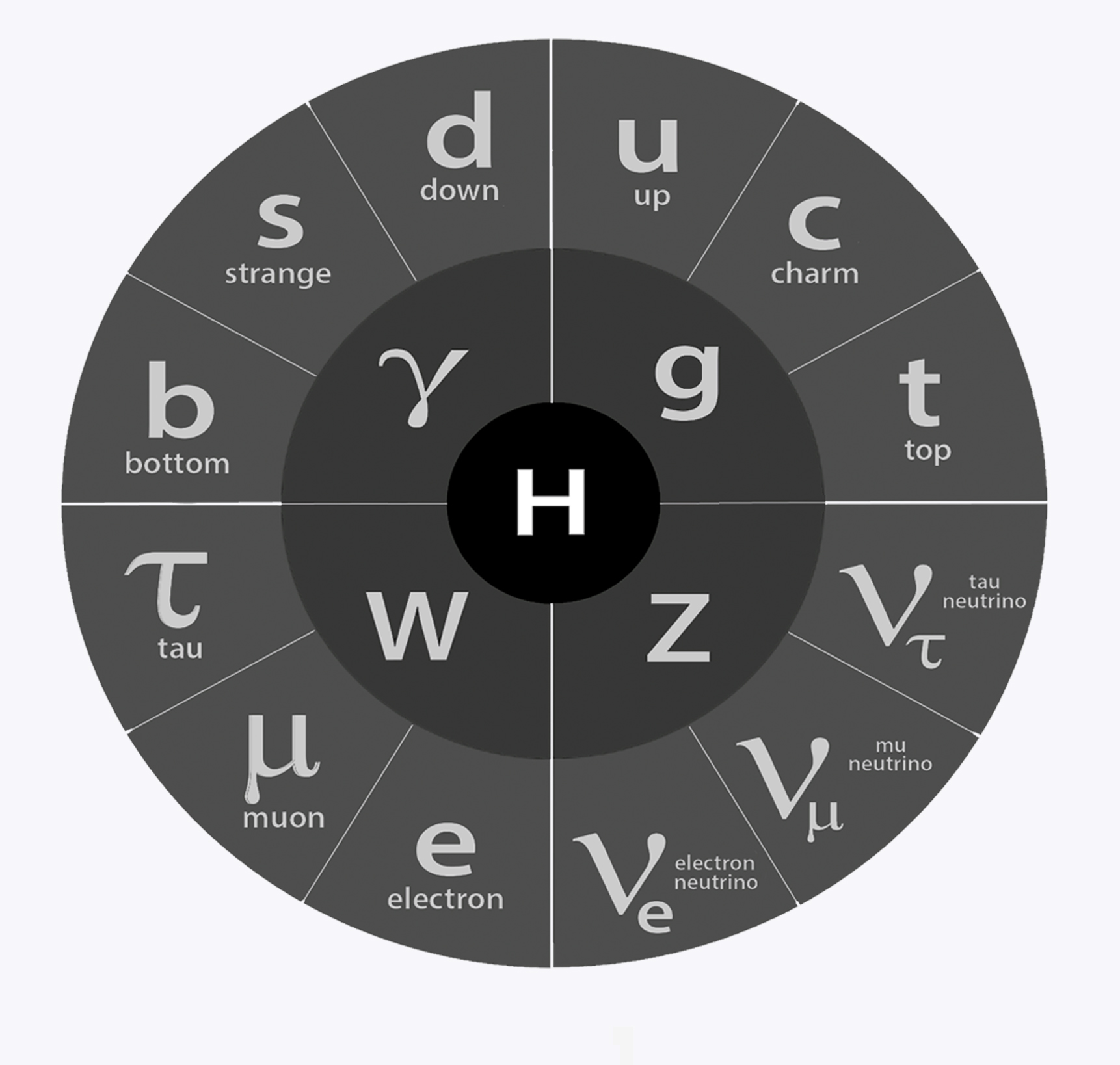
Since the 1950’s, the world’s most famous laboratory, CERN, has progressively unveiled Nature’s electroweak hierarchy (Z, W, Higgs) unrecognized as archetypes of Golden Mean protocol. As the central character in the 5-fold electroweak story, Higgs dates back to the 1960’s, roughly fifty years before CERN’s particle beams were luminous enough to collide and subsequently glimpse its cosmological manifesto—a boson of mass signature 126.873 GeV, or 888.111 / 7. As superconductive force carriers of an ancient, primordial metric, electroweak bosons are quite different from fermionic protons, neutrons, and electrons common to the Earthly plane. Their morphologically transformative powers hover over the virtual flavors of materialization, whose Golden Mean attenuations apply a neutron : electron mass-ratio (1838.16) modulated by a Z-boson mass (183.816 / 2), first publically announced to the world on 6-18-83, and followed by a W-boson mass-resonance at 161.838 / 2 GeV.
299.700 = 126.873 (H) + 080.919 (W) + 091.908 (Z)
Amicable Numbers
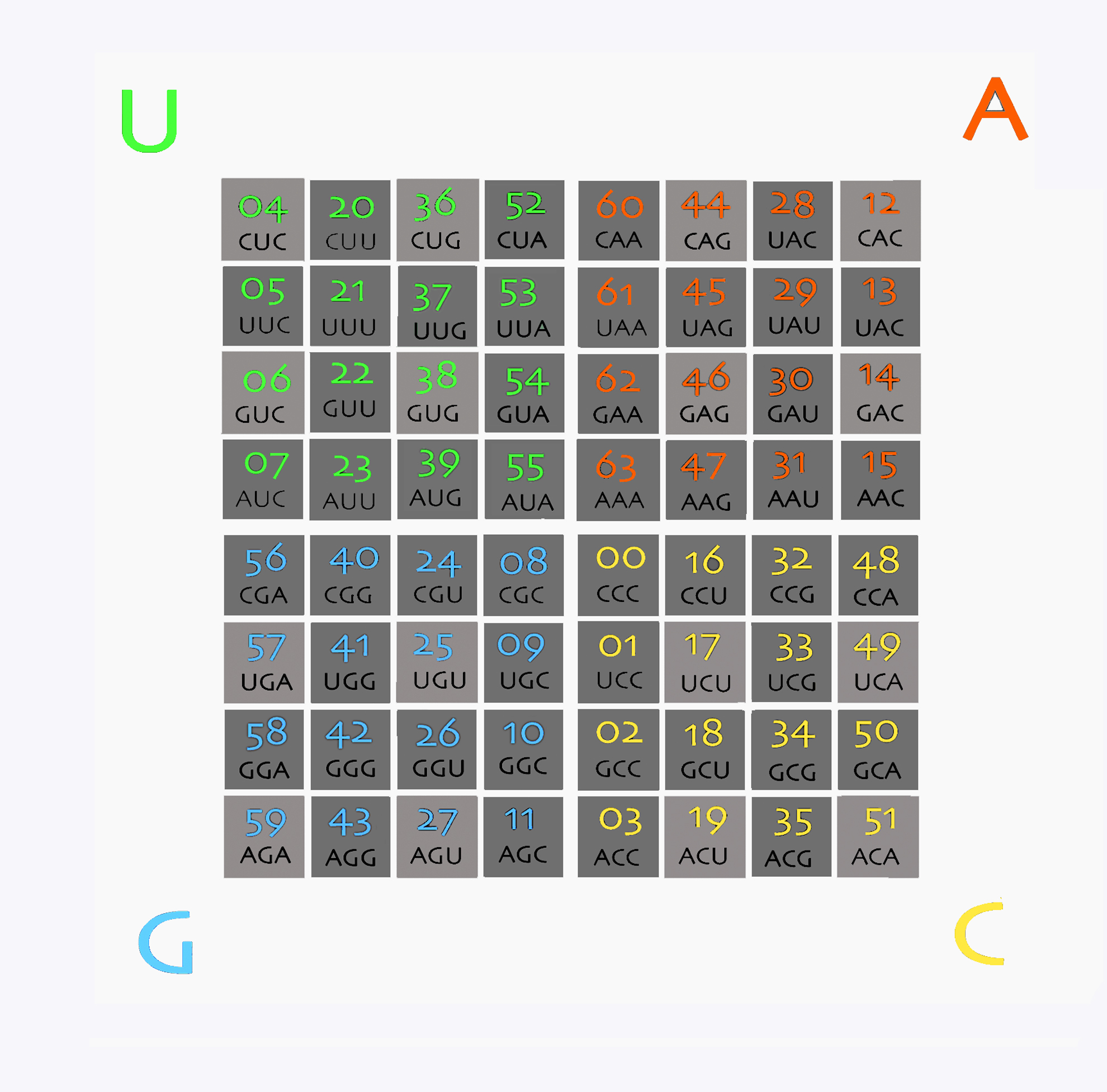
At left, 3 x 3 diagonals nested inside larger 4 x 4 quadrant colors using Magic Square “Constants” to spatially integrate positional weight values by hydropathic uniformity, emphasizing second-letter codon positions (U = green, A = red, C = yellow, G = blue). By example, CUG - GUC and CUC - GUG use Magic Square constants 30 and 34 in accordance with formulas, 4^3 - 4 / 2 and 4^3 + 4 / 2. Diagonal pairing of codons with sum 55 (green and yellow) are distinct from 71 (red and blue). These complementary values derive from the first two amicable numbers credited to Pythagoras, 22 and 284. Ergo, 220 / 4 = 55 and 284 / 4 = 71.
Octagonal Nuclear Pore
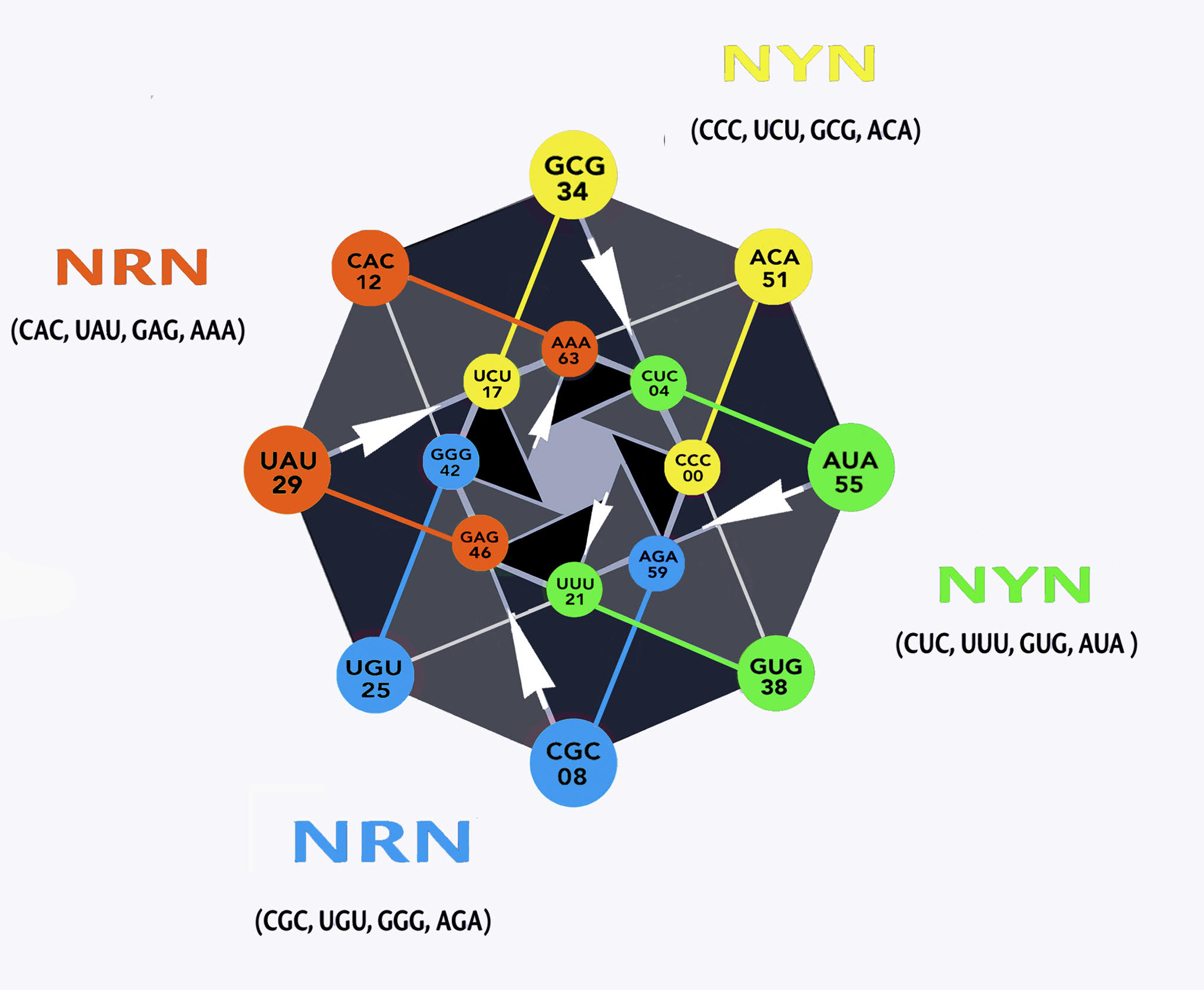
When imagining the limits of Nature, science is held hostage to one criteria— the perceived degree of internal complexity possible at a given size scale. Technologists have no problem envisioning life at the cellular level now that microscopes are commonplace, but ask them how Planck’s constant of radiation symbolically unifies DNA’s 64 codons, and the numerology does not fit any anticipated vision. Why should the number 662337 possess any unifying criteria for projecting biological appearance, unless energy-wavelength proportions are inherent in DNA’s graphical signaling output? Herein, each codon’s hydropathic second letter color-grouping is cross-networked by hydrogen’s 1008 mass-symbolism (59^2 - 67^2) and Planck’s idealized constant, 662337 (5967 x 111). This toroidal hypercubic model of a nuclear pore's 8+8 octagonal rings describe NYN + NRN Higgsian decomposition whose hierarchical codon ambiguities are N = ANY and R = purine, and Y = pyrimidine (see black parentheses).
None of this would be possible if time, gravity, and our DNA were not under the precise control of number’s hyper-dexterity. It is only because of number’s exquisite mechanical programming of DNA’s biological servitude, that 11:11 or 3:33 is able to communicate its subtle but extraordinary power that aligns spacetime. The correctness of this moment lives in the fact that palindromic code as a temporal symmetry, wields the technical ability to correct errors and restore image space—ergo it calculates and calibrates hydrodynamic displacement fields both spatially and temporally.